حلول المؤسسات وتقنية المعلومات
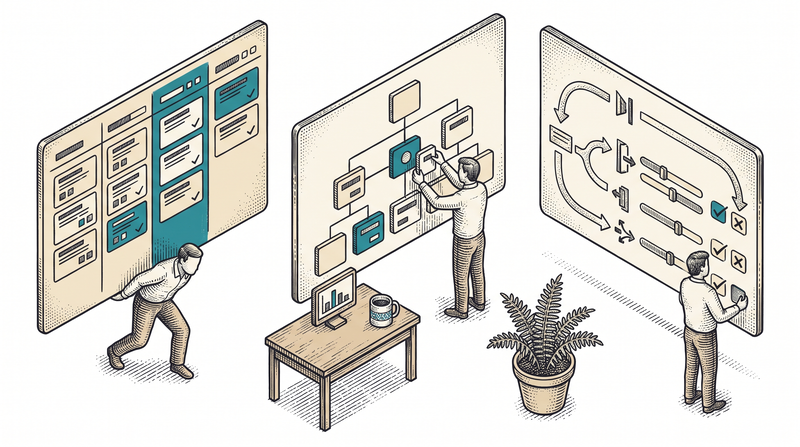
One backbone for a company's internal software
In a growing company work usually scatters across ten separate tools, countless spreadsheets and email threads: project tracking in one place, leave requests in another, documents in a folder, approvals in an inbox. Vosetu unifies that sprawl on one platform — from projects to HR, from the service desk to document management, with the same permissions, the same audit trail, the same interface language.
Designed for companies between 20 and 5,000 staff; it starts with a small team and grows module by module as the organization matures. Data-protection and occupational-safety requirements aren't patched on later — they're built into the architecture from day one.
- 20–5,000 employees
- Role-based access
- Audit trail as standard
- Privacy & safety compliant
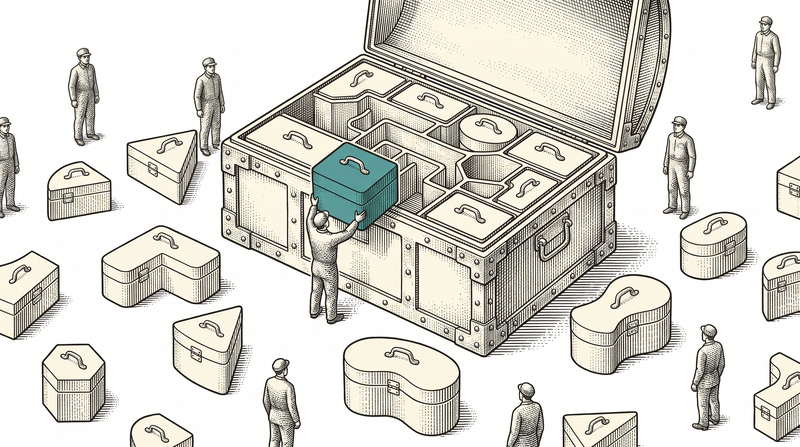
One platform, the whole internal operation
Modules turn on independently yet share the same users, permissions and data model — start with project tracking today, add HR and document management tomorrow.
Project & work tracking
Kanban, sprints and workload boards; with tasks, subtasks and dependencies.
Request & service desk
Internal support requests (ITSM): with categories, priority, SLA and resolution-time tracking.
HR & leave management
Personnel records, leave, timesheets and org chart — payroll-ready data.
Approval flows
Purchase, expense, leave and document approvals with multi-step, conditional rules.
Electronic documents (EDMS)
Incoming-outgoing correspondence, versioning, e-signature and archive; with full-text search.
Privacy & data protection
Personal-data inventory, access logging and retention-period rules built in.
Occupational health & safety
OHS training, equipment, incident and inspection records; with reminders and reports.
Inventory & assets
Fixtures, devices and licenses; who was assigned what and when, on record.
What runs beneath the surface
Workflow engine
Every approval, state transition and automated step is defined in a single engine. When a rule changes you edit one place, not 'if' blocks scattered across screens — the process is a configurable asset, not something buried in code.
- Multi-step, conditional approval
- SLA, escalation and reminders
- State-transition audit trail
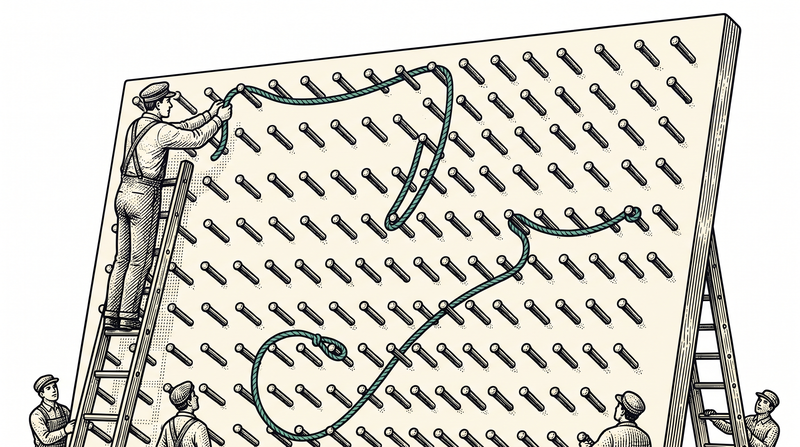
Role-based access & audit
Who can see what, who can approve, who can edit — all managed centrally through roles. Every critical action is logged with who, when and from which IP; auditing is default behavior, not an afterthought.
- Fine-grained roles and permissions
- Immutable audit log
- Single sign-on via LDAP/AD
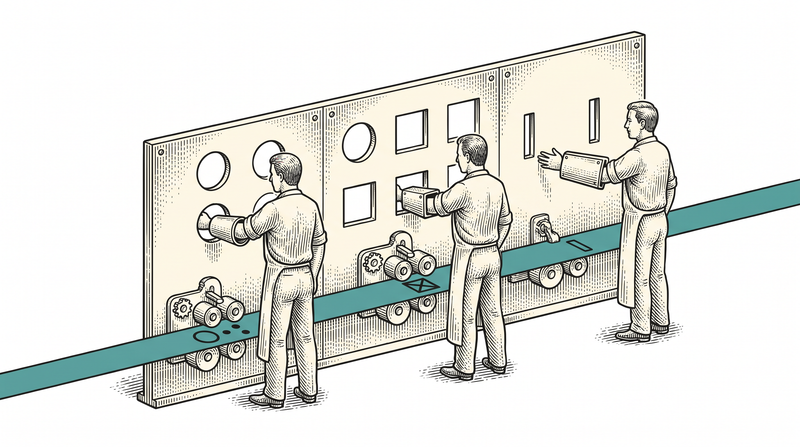
Dashboards & reports
Managers see open workload, pending approvals and bottlenecks at a glance. Dashboards adapt to the role; a team lead and an executive look at the same data at different resolutions.
- Role-tailored dashboards
- Excel/PDF export
- Scheduled email reports
Enterprise integrations
The platform talks to your existing systems: e-signature and e-government services, the LDAP/AD directory, accounting and payroll software, SMS and email gateways. Adding a new system means writing an adapter, not touching the core.
- e-signature & e-government
- LDAP/AD & accounting/payroll
- Modular adapter architecture
What ships as standard in every deployment
How we go from discovery to live
Discovery & process mapping
We work with your teams to map the real workflows and decide together which module comes first.
Backbone & access setup
We set up users, roles and the org chart, then stand up the first module with live data.
Module-by-module rollout
From project tracking to HR, from EDMS to the service desk; each module is piloted then rolled out.
Go-live & ongoing care
After training, data migration and integrations, we stay with you under an SLA maintenance plan.
The technology we build on
- .NET 9
- ASP.NET Web API
- PostgreSQL
- Redis
- Angular
- Next.js
- TypeScript
- Tailwind CSS
- Flutter
- SignalR
- Docker
- MinIO
- SLA
- LDAP/AD
- OAuth2
- e-signature
- e-Devlet
In enterprise software, order is not a feature you add later. The gate decision lives in one place, permissions don't scatter across screens, the audit trail is there from day one — discipline is worth more than the most expensive feature.
Frequently asked
Do we have to deploy everything at once?
No. You usually start with a single module (often project/work tracking), then add HR, EDMS, the service desk and the rest in order of need. Because they share the same user and permission model, adding later is painless.
Does it connect to our existing Active Directory and accounting system?
Yes. Single sign-on via LDAP/AD, e-signature and e-government services, accounting/payroll and SMS/email gateways are supported. A new system is added as an independent adapter without touching the core.
How are privacy and occupational-safety requirements met?
A personal-data inventory, access logging, retention rules and an audit trail are built into the architecture; the OHS module manages training, equipment and incident records. These aren't patched on later — they ship as standard.
How long does a typical deployment take?
It ranges from 3 to 12 months depending on scope. The first module usually goes live in a few weeks; the rest is rolled out module by module with pilot teams.
Do you provide support after launch?
Yes. Post-launch maintenance with an SLA is standard: bug fixing, security updates and new-module/enhancement requests are handled under contract.
Let's unify your internal operation on one platform
We'll listen to your processes and map out where to start, together. The first conversation is non-binding.