Öffentlicher Sektor & Kommune

Citizen-facing service, accountability inside the institution
The core promise of a public institution or municipality is trust: every application must be traceable, every request tied to an owner, every decision explainable in reverse. When a citizen files a petition they should see where it went; when a team goes out to the field, what they did should be on record. Vosetu turns that expectation into a technical default — instead of scattered ledgers, signed paper and lost emails, a single service backbone with an end-to-end trail.
What we bring to this vertical is engineering discipline: across our healthcare, finance and logistics projects we made talking to national systems a habit. Integrating with the e-government gateway, e-signature, and official authorization and query services is not a new adventure for us but a repeated engineering pattern. And data protection is not a clause bolted on later — it lives inside the architecture from the first line.
- e-government & e-signature experience
- End-to-end audit trail
- Privacy built in from day one
- Field + citizen, one backbone

How we start a public-sector project
Regulation & process discovery
We talk about the process before the software: which application lands in which unit, which approval is mandatory, which data is visible to whom. We put the relevant regulation and internal practice on paper together.
Integration & access architecture
We design the national and internal systems the institution will connect to, the role tree and the audit rules. Who sees what, who approves, which action leaves a trace — all settled up front.
Pilot with one unit / district
We trial with a single directorate or district on real data rather than the whole institution at once. We see friction in the field and fix it before rolling out.
Go-live & ongoing maintenance
After training, data migration and integration testing we roll out, then handle regulatory changes and new requests under an SLA maintenance plan.
What runs beneath the surface
Application & request workflow engine
The path a petition, complaint or permit application follows is defined in a single engine: which unit it lands in, how many approval steps it passes, whom it escalates to when its deadline lapses. When a rule changes you edit one place, not conditions scattered across screens — the process is a configurable asset, not something buried in code.
- Multi-step, conditional approval
- Deadline breach and escalation
- Status notification to the citizen

Role-based access & audit trail
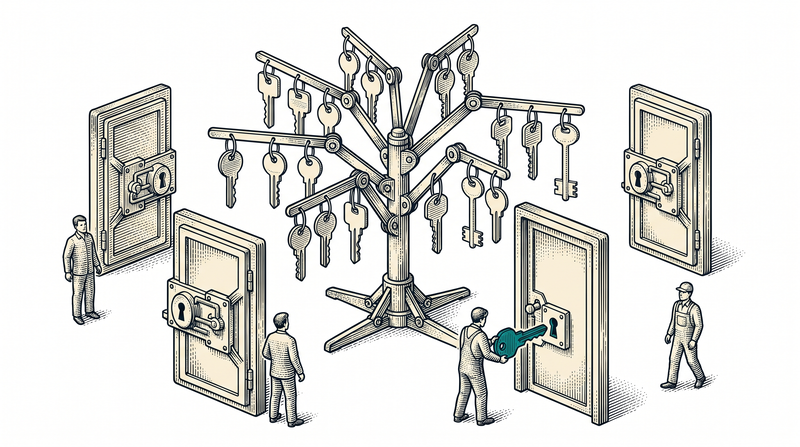
In the public sector, who may see what is a legal question, not a technical preference. Access is managed centrally through roles; every critical action is written to an immutable log with who, when and from which IP. An application's fate does not 'get lost on someone's desk' — every step has an owner and a timestamp in the system.
- Fine-grained roles and permissions
- Immutable audit log
- Privacy access and retention rules

National system integrations
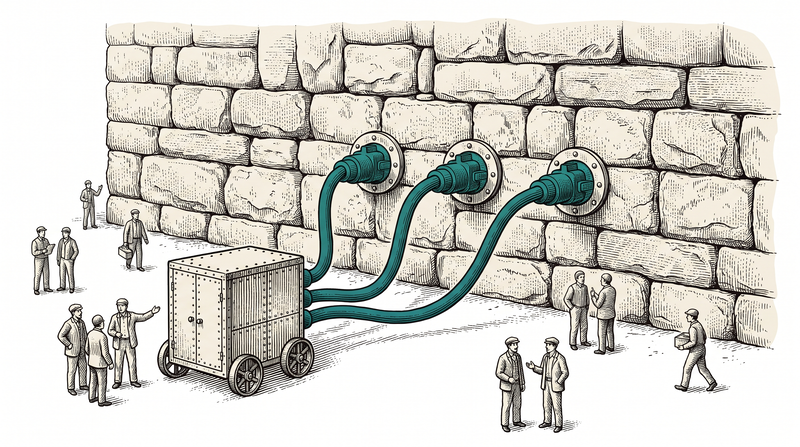
The institution talks to the existing official backbone: identity and application via the e-government gateway, paperless approval via e-signature, payment and collection services, the internal directory and accounting. We've worked with such national services in the healthcare and finance verticals; adding a new one means writing an adapter without touching the core.
- e-government & e-signature
- Payment & collection services
- Modular adapter architecture
Field-team dispatch & location
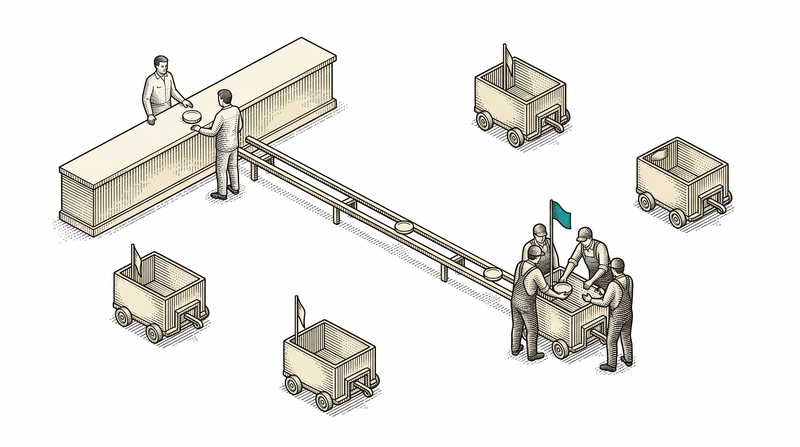
A citizen request drops to the field as a work order: which team, which address, when. The team accepts the job from a mobile app, adds photos and notes, marks it done; location and time are recorded. The office tracks open jobs on one board — no need for phone traffic.
- Automatic flow from request to work order
- Mobile acceptance, photo and location proof
- Open-job board and duration tracking
From citizen to field, one service backbone
Modules turn on independently yet share the same citizen record, access tree and audit trail — a request that comes in on one channel doesn't vanish on another.
Online application portal
Citizens sign in with identity verification, open their application and track its status step by step — without visiting the institution.
Request, complaint & suggestion
Every report is logged with a category, priority and responsible unit; resolution time and feedback are tracked.
Field dispatch
Requests are assigned to teams as work orders; they close with mobile acceptance, location and proof of completion.
Permit & license
Business-opening, zoning and various permit processes run with multi-step approval and document checks.
Collection & debt query
Citizens query their debt and pay online; the collection record advances in reconciliation with accounting.
Correspondence & documents
Incoming-outgoing correspondence, versioning, e-signature and archive; fast access to history via full-text search.
Announcement & notification
Status, appointment and announcement notices to citizens via SMS and email — managed from one channel.
Privacy & data protection
Personal-data inventory, access logging and retention rules are built into the architecture, not a module.
What ships as standard in every public deployment
In public software the most valuable feature is accountability, and it can't be bought later. When every application has an owner, every decision a timestamp and every access a trace, trust follows on its own — transparency is not a screen, it is the architecture itself.
Frequently asked
What do you bring ready on the public-sector side?
A repeated engineering pattern: across our healthcare, finance and logistics projects we have built integration with national systems (identity, authorization, payment, e-signature) and privacy-compliant data handling many times over. The application flow, role-based permissions and the audit trail are parts of that pattern; the solution for an institution is built on top of them.
Can e-government and e-signature integration be done?
Yes. Identity and application via the e-government gateway, paperless approval via e-signature, and official query/payment services can be supported. Each official service is added as an independent adapter without touching the core; when regulation or a service changes, only that adapter is updated.
Is citizen data processed in line with privacy law?
Yes. A personal-data inventory, access logging, retention-period rules and an immutable audit trail are built into the architecture. Who opened which record and when is logged; access to sensitive data is restricted by role. These aren't patched on later — they ship as standard.
Can we connect field teams to the system too?
Yes. Citizen requests drop to the field as work orders; the team accepts a job from a mobile app, adds photos and notes and closes it with location proof. The office tracks open jobs on one board and sees durations and completion rates.
Let's design your institution's service flow together
We'll listen to your processes and regulation and map out where to start, together. The first conversation is non-binding.